
- tek_electric
What Does a Home Addition Electrician Actually Do During an Expansion Project?
Expanding a home changes far more than its physical footprint. When new square footage is added, the electrical system must evolve in parallel to support increased lighting loads, receptacle demand, HVAC expansion, appliance integration, and modern technology infrastructure. Electrical systems are engineered with calculated capacity limits. If an addition is connected without proper recalculation and system review, the result can be overloaded breakers, overheating conductors, voltage imbalance, or long-term safety hazards.
A qualified home addition electrician plays a structural role in the success of an expansion project. Their responsibility goes beyond running new wires. They assess service capacity, perform NEC-compliant load calculations, design circuit distribution, verify the integrity of grounding and bonding, coordinate inspections, and ensure that the new structure integrates safely into the existing electrical infrastructure. Understanding these responsibilities reveals why electrical planning must occur at the earliest stages of an expansion project.
Evaluating Existing Electrical Infrastructure Before Construction Begins
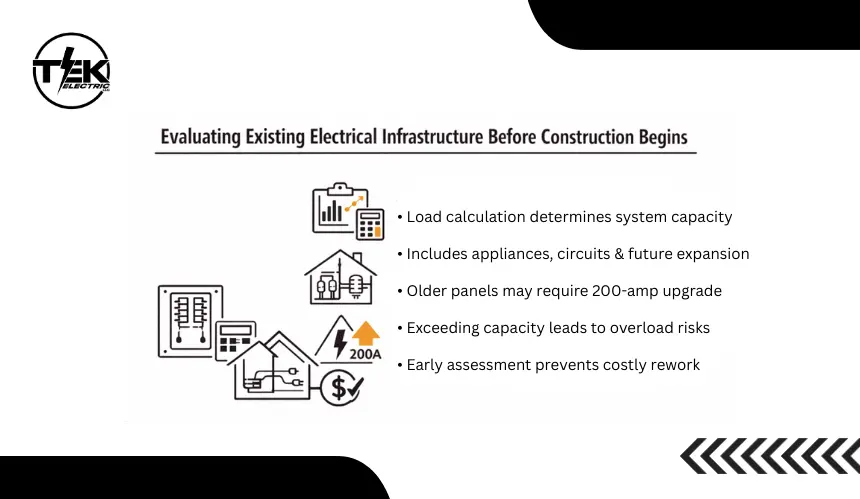
Before any framing or drywall begins, the electrician must determine whether the existing system can safely support the added demand.
NEC-Compliant Load Calculation and Demand Analysis
The National Electrical Code (NEC) provides a structured methodology for calculating residential load demand. A home addition electrician evaluates:
- General lighting load based on total square footage
- Small-appliance branch circuits
- Fixed appliances such as dishwashers, ovens, and HVAC equipment
- Laundry circuits
- Continuous loads operating for three hours or longer
- New projected circuits for the expansion
Continuous loads must be calculated at 125% of their rated amperage to prevent conductor overheating. This demand-factor analysis determines whether the service panel has sufficient headroom for expansion. Without proper load calculation, additional circuits may exceed panel limits and create persistent nuisance trips.
Service Panel Capacity Assessment
Many older homes were built with 100-amp service. While this was adequate decades ago, modern expansions frequently require 200-amp service or more. If the projected combined load approaches or exceeds 80% of panel capacity, an upgrade becomes necessary.
In Reno, NV, many established properties that are undergoing additions were built before modern appliance standards were established, making panel reassessment especially common during expansion planning.
Designing New Circuits for the Added Space
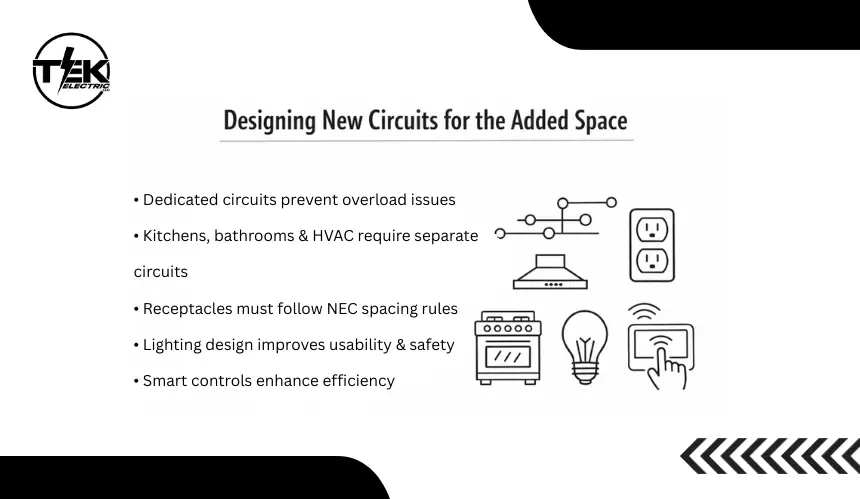
Electrical design for a home addition is not improvised. It follows strict code spacing, circuit allocation, and safety requirements.
Dedicated Circuit Requirements
Certain areas of the home require dedicated circuits under NEC rules:
- Kitchens require at least two 20-amp small appliance circuits
- Bathrooms require GFCI-protected receptacles
- Garages and outdoor receptacles require GFCI protection
- HVAC systems require dedicated disconnects
- Microwaves and electric ranges require individual circuits
Dedicated circuits prevent overload and ensure predictable performance.
Receptacle Placement and Code Spacing
The NEC requires receptacles every 12 feet along habitable walls and within specific distances of doorways and corners. Proper planning during framing ensures compliance without costly rework.
Lighting and Switching Design
Lighting layout must consider:
- Three-way switching for staircases and large rooms
- Dedicated circuits for high-wattage lighting
- Integration of dimmers and smart controls
Thoughtful design improves usability and prevents overloading mixed-use circuits.
Integrating the Addition Into the Existing Distribution System
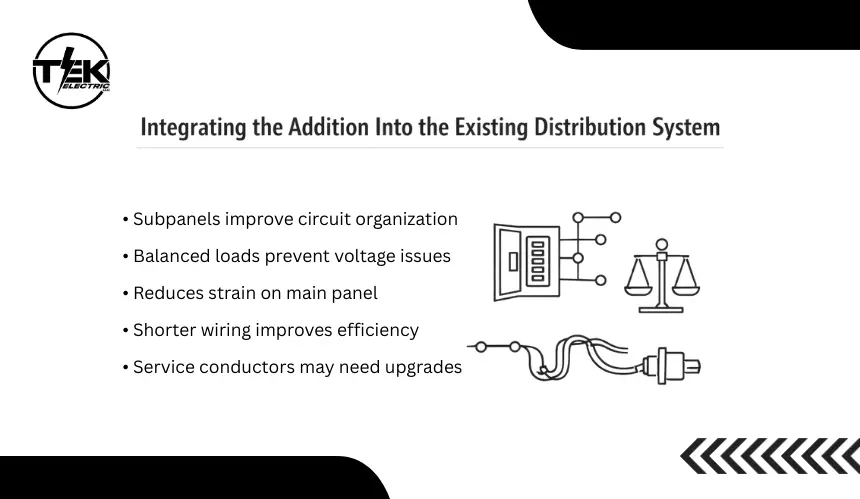
Electrical additions must function as an extension of the original infrastructure rather than an isolated system.
Subpanel Installation and Distribution Efficiency
If the main panel lacks physical breaker space but still has amperage capacity, installing a subpanel allows organized distribution of new circuits. Subpanels reduce long cable runs and improve system manageability.
Phase Load Balancing
Electricians balance circuits across both legs of a 240-volt residential service. Uneven load distribution can cause voltage fluctuations, inefficient appliance operation, and premature equipment wear.
Service Entrance Conductor Review
If the addition significantly increases service demand, incoming conductors and the meter base may need to be replaced to match the upgraded amperage rating.
Grounding, Bonding, and Fault Protection Upgrades
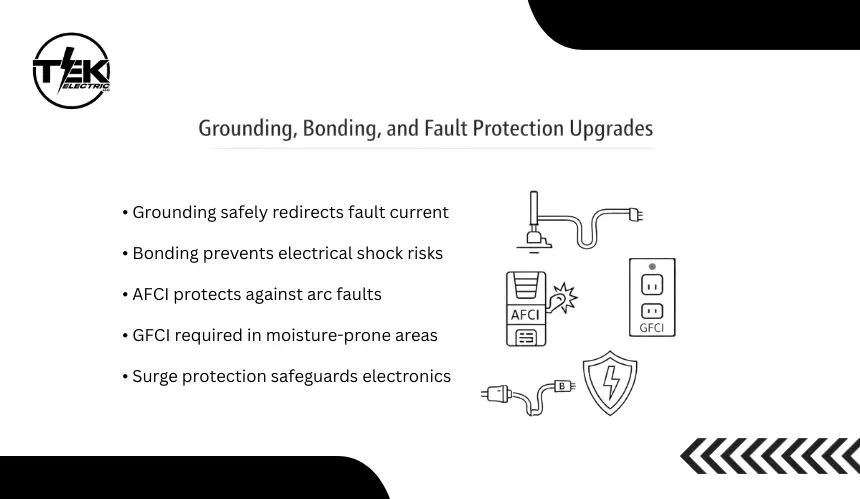
Safety systems must expand and adapt in proportion to rising electrical demand to prevent overload conditions, arc faults, and shock hazards. As new circuits, higher amperage appliances, and additional distribution points are introduced, protective devices such as AFCI breakers, GFCI receptacles, properly sized overcurrent protection, and upgraded grounding and bonding systems become increasingly critical.
Grounding Electrode System Verification
Proper grounding ensures that fault current safely returns to earth. This includes verifying:
- Ground rods
- Bonding to metallic water piping
- Proper grounding electrode conductor sizing
Bonding Metal Enclosures and Conduit
All metallic components must be bonded to prevent energization during a fault. Bonding ensures that overcurrent devices trip promptly under fault conditions.
AFCI and GFCI Protection Requirements
Modern code mandates Arc Fault Circuit Interrupters in most habitable areas to prevent fire hazards from arcing conductors. Ground Fault Circuit Interrupters are required in areas exposed to moisture.
Whole-Home Surge Protection
Panel-mounted surge protection devices shield sensitive electronics from voltage spikes caused by lightning or grid instability.
Environmental factors influence system design. Elevated attic temperatures affect conductor ampacity ratings, while seasonal shifts in HVAC demand impact load calculations. In Reno, NV, hot summers and cold winters require thoughtful wire sizing and panel capacity planning to accommodate fluctuating demand.
Coordinating Electrical Work With Structural Construction
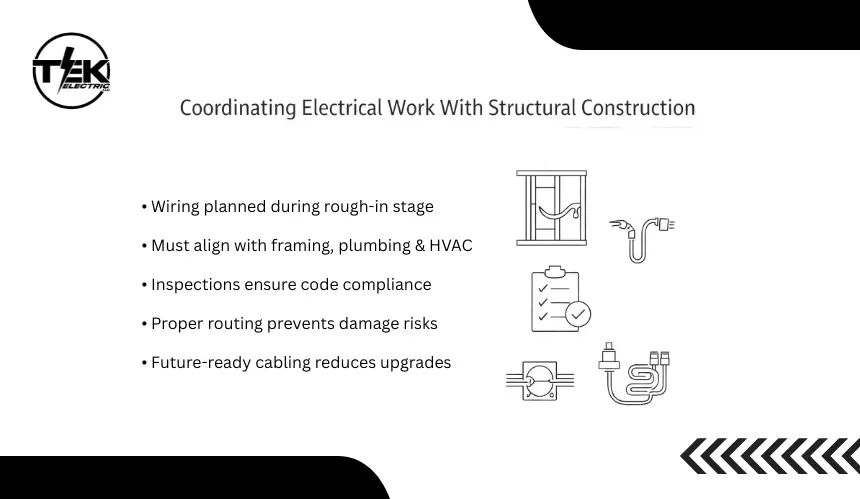
Electrical installation must be carefully coordinated with framing layouts, insulation placement, plumbing runs, and HVAC ductwork to ensure system integrity and code compliance. Wiring pathways must avoid structural weakening of load-bearing members, maintain required clearances from gas and water lines, and remain accessible for inspection.
Conductor routing must also account for insulation depth to prevent overheating, especially in attic or exterior wall assemblies. Without proper coordination among trades, conflicts can lead to compressed cables, improper drilling, failed inspections, or reduced system performance long after the walls are closed.
Rough-In Wiring Stage
During rough-in, cables are routed through studs and joists before drywall installation. Proper drilling, spacing, and protective nail plates prevent future mechanical damage.
Inspection Milestones
Electrical work typically undergoes two inspections:
- Rough inspection before drywall
- Final inspection after devices, breakers, and panels are installed
Inspectors verify conductor sizing, proper breaker installation, labeling accuracy, and grounding integrity.
Structured Cabling and Future Technology Planning
During open-wall construction, electricians may install:
- Conduit pathways for future expansion
- Structured Ethernet cabling
- Low-voltage wiring for security systems
- Smart lighting control infrastructure
Planning ahead reduces the need for invasive retrofits.
Addressing Common Technical Challenges
Home additions frequently reveal underlying electrical constraints that were previously manageable under lower demand conditions. What once functioned adequately for a smaller footprint can quickly become insufficient when additional circuits, lighting loads, HVAC systems, or high-draw appliances are introduced. Expansion projects often uncover undersized service panels, overcrowded breaker spaces, outdated aluminum wiring, improper grounding, or limited amperage capacity. These hidden limitations must be identified and corrected early in the planning phase to prevent overload conditions, code violations, voltage instability, and costly rework after construction progresses.
Outdated Wiring Compatibility
Older sections of the home may contain aluminum branch wiring or undersized conductors. These systems must be evaluated for compatibility with modern expansions.
Voltage Drop Over Extended Runs
Large additions increase circuit length. Voltage drop must be calculated to ensure proper conductor sizing and maintain appliance performance.
Limited Panel Space
Even if amperage is sufficient, limited breaker space can restrict expansion. Strategic reorganization or panel replacement resolves this issue.
Expanding Square Footage Requires Expanding Capacity
A home addition increases electrical complexity, load demand, and safety requirements. Proper planning ensures that new spaces integrate seamlessly into the existing system without compromising performance.
A skilled home addition electrician evaluates infrastructure, performs accurate load calculations, upgrades protective systems, and designs circuits that align with both current needs and future expansion. When electrical systems evolve alongside structural expansion, homeowners gain a safe, reliable, and scalable living environment built to meet modern energy demands.
Frequently Asked Questions
Do all home additions require an upgrade to the electrical panel?
Not necessarily. A load calculation determines whether existing capacity can handle the increased demand. Smaller additions may only require additional circuits.
How long does electrical installation take during an expansion?
Rough wiring may take several days, depending on the size of the job. Complex additions, such as panel upgrades or subpanels, may extend timelines.
Are permits mandatory for electrical additions?
Yes. Permits and inspections ensure compliance with code standards and verify safe installation practices.
Can an addition share circuits with existing rooms?
Code typically requires new circuits for added spaces to prevent overload and ensure compliance.
Does adding square footage significantly increase power demand?
Most additions increase lighting and receptacle load. Kitchens, offices, and climate-controlled rooms substantially increase overall demand.